1. Introduction: The Biological Cost of Business
In the high-stakes environment of Austin’s corporate landscape—from the venture capital boardrooms of downtown to the tech campuses of The Domain and the private estates of Westlake—physical integrity is often the most undervalued asset on the balance sheet. For the modern executive, the body is the primary vessel of business execution. Yet, the very behaviors that drive financial success—prolonged negotiations, intense focus at workstations, and the relentless cognitive load of decision-making—extract a severe biological tax.
The modern industrial athlete faces a paradox: their career requires high-output stamina, but their work environment actively degrades the structural machinery required to sustain it. Shoulder pain in this demographic is not merely a somatic nuisance; it is a strategic liability. It represents a constant, low-level “leak” in cognitive endurance, a distraction during critical operations, and a limiting factor in long-term career viability. When a CEO cannot raise their arm without a sharp catch of pain, or when a founder cannot sleep due to a dull ache in the deltoid, their “decision capital” is compromised.
RxFit has established itself as the premier concierge solution for this specific crisis. Unlike traditional personal training, which focuses on vanity metrics or caloric expenditure, or standard physical therapy, which is constrained by insurance caps and “baseline” recovery goals, RxFit operates on a distinct paradigm: Asset Protection and Optimization.1 Led by Corrective Exercise Specialist Danny Trejo, the firm delivers mobile, biomechanically focused training directly to the homes and offices of Austin’s elite. The protocol is designed to reverse the structural depreciation caused by the modern desk-centric work environment, specifically targeting the epidemic of shoulder dysfunction among high-performers.
This report serves as a definitive operational dossier for the “Industrial Athlete.” It provides an exhaustive analysis of the RxFit methodology, the nuanced biomechanics of the “Executive Shoulder,” and the economic rationale for mobile, corrective training. It is written not for the casual gym-goer, but for the professional who views their health through the lens of risk management and return on investment.
1.1 The Definition of the “Industrial Athlete”
The term “Industrial Athlete” is central to understanding the RxFit philosophy. It reframes the executive not as a sedentary worker, but as a high-performance individual whose “sport” involves mental acuity, stress management, and endurance rather than sprinting or tackling. Just as a professional quarterback requires a team to maintain his throwing arm, a professional executive requires a team to maintain their posture, spine, and shoulders. The demands are different, but the necessity for maintenance is identical. A breakdown in the physical “hardware” inevitably leads to a failure in the cognitive “software.”
1.2 The Failure of Traditional Fitness Models
Most executives attempt to solve musculoskeletal pain by hiring a traditional personal trainer to “get in shape.” This approach is often disastrously misguided. Traditional fitness industries are built on the principles of bodybuilding (hypertrophy) or cardiovascular exhaustion (calorie burning).
- The Calorie Fallacy: High-Intensity Interval Training (HIIT) camps focus on metabolic output. For an executive with structural dysfunction, performing high-rep burpees or overhead presses under fatigue is a mechanism for injury, not health.
- The Mirror Trap: Traditional training prioritizes the “anterior chain”—the muscles visible in the mirror (chest, biceps, abs). However, the modern executive is already dominant in the anterior chain due to the hunched desk posture. Strengthening the pectorals of a desk worker without correcting their posture is akin to tightening the bowstring on a bow that is already ready to snap. It exacerbates the hunch, locking the shoulder blade into dysfunction.
RxFit’s philosophy is diametrically opposed to these models: “We do not load dysfunction.” The priority is structural integrity. Calorie burning is a byproduct of movement, not the primary goal. The objective is to re-engineer the tension relationships in the body to allow for pain-free, high-load performance.1
2. The Biomechanics of Depreciation: Why Executives Break
To understand the solution, one must first deeply understand the failure mechanism. High-performance executives rarely suffer shoulder pain from acute trauma, such as a fall or a sports collision. Instead, they suffer from structural depreciation—a slow, cumulative erosion of joint integrity caused by the very environment that enables their financial success: the ergonomic cage of the desk.4
2.1 Upper Crossed Syndrome: The Silent Epidemic
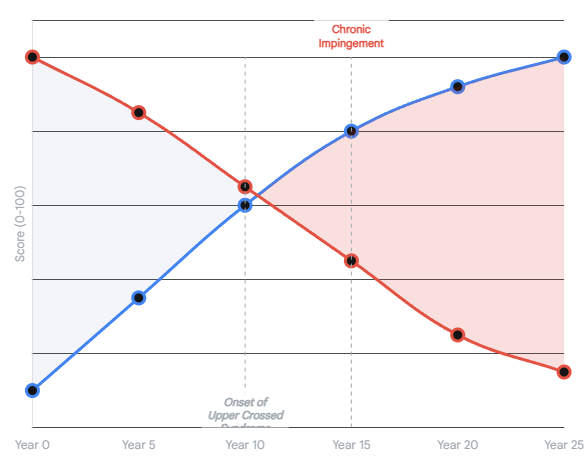
The foundational diagnosis for over 90% of desk-related shoulder pain is Upper Crossed Syndrome (UCS). This condition, originally identified by the renowned neurologist Dr. Vladimir Janda, describes a predictable pattern of muscle imbalance caused by prolonged sitting with a forward head posture. It acts as a “silent killer” of shoulder mechanics, altering the instantaneous axis of rotation of the joint.4
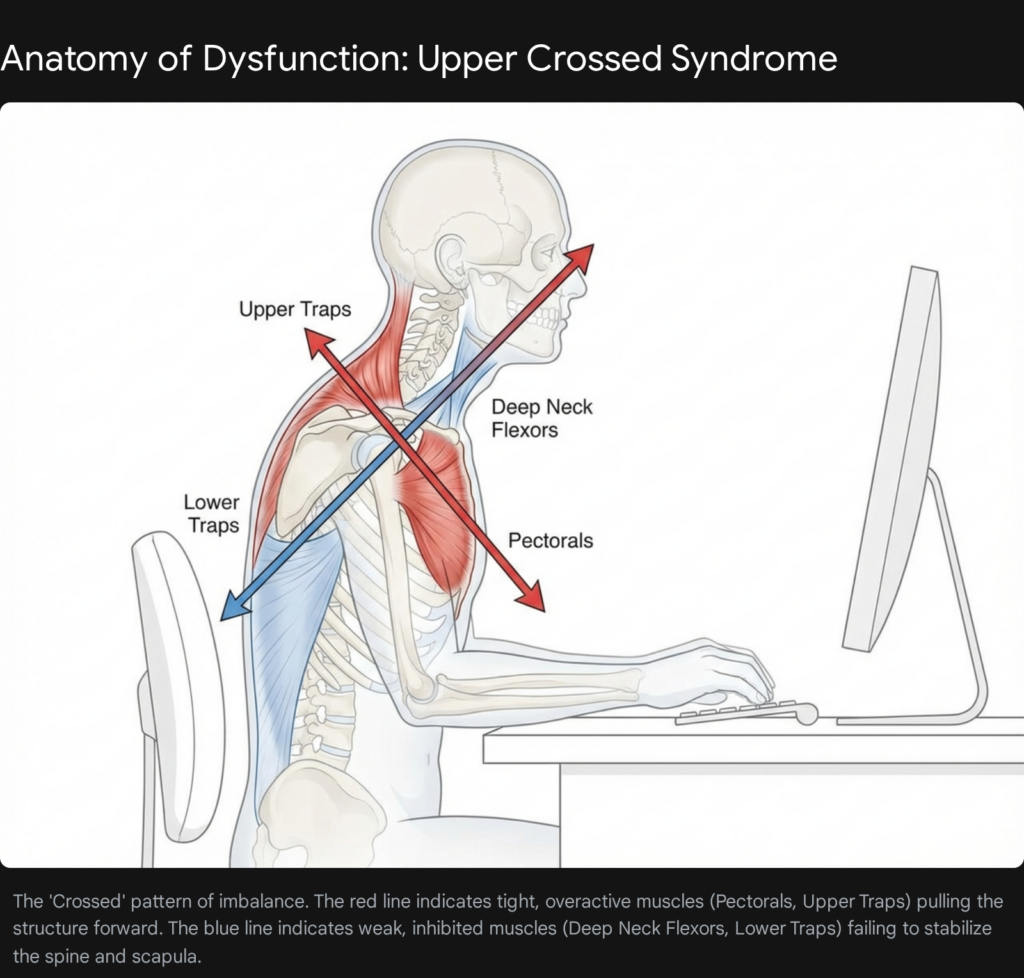
UCS is characterized by a “crossing” pattern of tightness (facilitation) and weakness (inhibition) that locks the upper body into a dysfunctional state.
The Tight Diagonal (The Brakes)
The first arm of the “X” consists of muscles that become hypertonic—short, tight, and overactive.
- Pectoralis Major & Minor: The constant position of typing, with arms in front of the body, chronically shortens the chest muscles. The Pectoralis Minor, in particular, attaches to the coracoid process of the scapula. When tight, it acts like a hook, tipping the shoulder blade forward (anterior tilt) and down. This is the primary driver of the “hunched” aesthetic.
- Upper Trapezius & Levator Scapulae: These are the “stress muscles.” Psychological stress triggers a primal protective reflex to shrug the shoulders toward the ears to protect the neck. Combined with the need to hold the head up against gravity (as it leans forward toward a screen), these muscles enter a state of permanent, low-grade contraction. They become ropy, painful, and riddled with trigger points.4
The Weak Diagonal (The Failures)
The second arm of the “X” consists of muscles that become hypotonic—long, weak, and neurologically inhibited.
- Deep Neck Flexors: These small muscles on the front of the cervical spine are responsible for tucking the chin and stabilizing the head. As the head drifts forward to read a monitor (Forward Head Posture), these muscles are deactivated. The burden of supporting the head (which weighs 10-12 lbs) shifts entirely to the posterior neck muscles, causing tension headaches.
- Lower Trapezius & Serratus Anterior: These are the critical stabilizers of the scapula. The Lower Trapezius is responsible for pulling the shoulder blade down and back, countering the elevation of the Upper Trapezius. The Serratus Anterior holds the blade flat against the ribcage. In a desk posture, these muscles are chronically stretched and “turned off.” The brain eventually forgets how to recruit them, leading to “gluteal amnesia of the shoulder”.4
2.2 The Mechanism of Impingement
The pain experienced by executives—often described as a sharp catch when reaching for a seatbelt, putting on a jacket, or performing an overhead press—is typically Subacromial Impingement. This is the direct mechanical consequence of Upper Crossed Syndrome.
The shoulder is a ball-and-socket joint, but unlike the hip (which is a deep, stable socket), the shoulder is more like a golf ball sitting on a tee. It relies entirely on soft tissue for stability. Above the “ball” (humeral head) sits a bony shelf called the acromion (part of the shoulder blade). The space between the ball and the shelf is the Subacromial Space. This narrow tunnel, often only millimeters wide, houses the tendons of the rotator cuff (specifically the Supraspinatus) and the subacromial bursa (a fluid-filled sac that reduces friction).
When an executive sits with UCS:
- Protraction: The shoulder blades slide forward around the ribcage.
- Anterior Tilt: The tight Pec Minor tips the acromion bone forward and down.
- Kyphosis: The thoracic spine (upper back) rounds forward, further changing the angle of the shelf.5
The result is a closing of the subacromial space. The ceiling of the tunnel is lowered onto the contents. When the executive raises their arm, the ball of the humerus rises, but the shelf does not move out of the way. The result is mechanical grinding: the acromion bone crushes the rotator cuff tendon and bursa against the humeral head.
- The Result: Inflammation, fraying of the tendon (tendinosis), and bursitis.
- The Sensation: A “pinching” pain in the front or side of the shoulder, often referring down the arm.
- The Vicious Cycle: Pain causes inhibition of the rotator cuff, which leads to further instability, which causes the humeral head to ride up even higher, increasing the impingement.9
2.3 The Thoracic Spine Connection
The thoracic spine (T-Spine) is the foundation upon which the shoulder girdle rests. A healthy T-Spine should be capable of extension (arching back) and rotation. However, desk work locks the T-Spine into Hyperkyphosis—a rigid, C-shaped curve.
When the T-Spine cannot extend, the shoulder blade cannot tilt backward. To raise the arm overhead, the body must compensate. Often, the executive will arch their lower back (Lumbar spine) or shrug their shoulder excessively to get the hand up. This compensatory movement pattern creates a “false” range of motion that shreds the shoulder joint while simultaneously stressing the lower back. RxFit’s protocol recognizes that you cannot fix the shoulder without unlocking the spine.11
3. The RxFit Methodology: Corrective Engineering
RxFit bridges the gap between the clinical sterility of physical therapy and the unrefined intensity of commercial gyms. The company is built on the premise that the executive body requires re-engineering, not just “exercise.” The methodology is led by founder Danny Trejo, whose background informs a unique clinical-performance hybrid approach.1
3.1 The Founder’s Philosophy: “Fix the Joint First”
Danny Trejo is a Corrective Exercise Specialist (CES) accredited by the National Academy of Sports Medicine (NASM), with a background in biology and microbiology. Unlike many celebrity trainers who are genetically gifted former Division 1 athletes, Trejo describes himself as having “average genetics” and a history of personal injury, including a herniated disc. This lack of “phenom talent” is his competitive advantage. It forced him to develop an obsession with foundational biomechanics and efficiency. He could not rely on brute strength or genetic resilience; he had to rely on leverage, alignment, and science.2
His mantra, “We fix the joint first,” dictates that no load is applied to a dysfunctional system. If a client cannot move their shoulder blade cleanly across their ribcage (scapulohumeral rhythm), they are prohibited from picking up a dumbbell. This rigorous gatekeeping protects the client from the common “fitness injury” cycle where gym work exacerbates office dysfunction. Trejo notes, “We don’t train athletes for competition; we train professionals for promotion.” The goal is longevity and daily energy, not peak athletic output at the cost of health.3
3.2 The Mobile Concierge Model
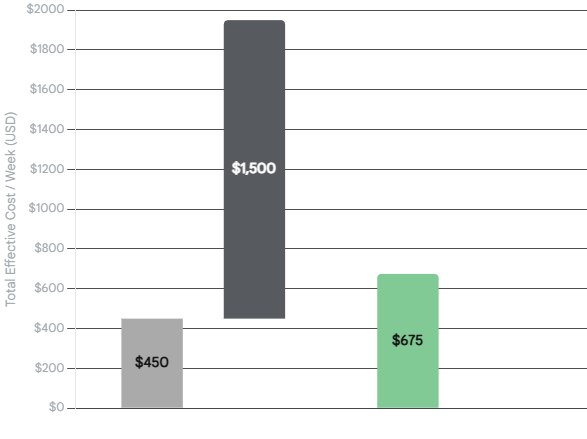
RxFit operates as a high-end mobile service, eliminating the friction of traditional fitness. The “gym” arrives at the client’s door. This is not merely a convenience; it is a compliance strategy. For an executive billing $500 to $1,000 per hour, the logistical cost of going to a gym—driving, parking, changing, waiting for equipment, showering, driving back—often exceeds the cost of the training session itself.
- Service Areas: The company explicitly targets Austin’s executive hubs: Downtown, The Domain, Rollingwood, Westlake, and Tarrytown.
- The Setup: Trainers arrive with a complete mobile corrective suite. This typically includes massage tables for manual release, resistance bands for activation, adjustable dumbbells for loading, and specialized tools like TRX suspension systems or myofascial release tools. The environment is controlled, private, and hyper-efficient.1
3.3 Comparative Analysis: RxFit vs. Physical Therapy vs. Personal Training
A frequent query from prospective clients is the differentiation between RxFit and medical Physical Therapy (PT). While PT is the gold standard for acute, post-surgical rehabilitation, it has systemic limitations for the high-functioning executive who is not “injured” enough for surgery but too painful for high performance.
| Feature | Physical Therapy (Standard) | RxFit Corrective Mobile Training | Traditional Personal Training |
| Primary Goal | Return to “Baseline” (Activities of Daily Living). | Optimize for High Performance & Longevity. | Aesthetics / Calorie Burn / Weight Loss. |
| Trigger | Acute injury or surgery referral. | Chronic stiffness, proactive health, performance. | Desire to “get fit” or lose weight. |
| Constraint | Insurance caps limit visits (e.g., 20/year). | Unlimited “Asset Management” relationship. | Sales quotas / Package expiration dates. |
| Modality | Symptom management (Ice, TENS, isolation). | Systemic biomechanical correction & strength. | High load, machine-based, isolation movements. |
| Environment | Clinical setting (requires commute/waiting). | Mobile Concierge (Home/Office/Gym). | Big Box Gym (Crowded, loud, public). |
| Intensity | Low Load / Rehabilitation focus. | Progressive Overload once dysfunction is cleared. | High Intensity (often disregarding form). |
| Cost Model | Co-pay/Insurance (Variable/Opaque). | Flat Concierge Rate (~$105/session). | Membership + Session Fees (Variable). |
Strategic Insight: Physical Therapy is often a “reactive” measure—repairing a broken asset. RxFit is a “proactive” measure—hardening the asset against failure. For an executive, the goal is not just to be pain-free while typing (the PT standard), but to be robust enough to ski in Aspen, play tennis at the Westwood Country Club, and endure 14-hour days without fatigue.15
4. The Executive Repair Protocol: 4 Phases
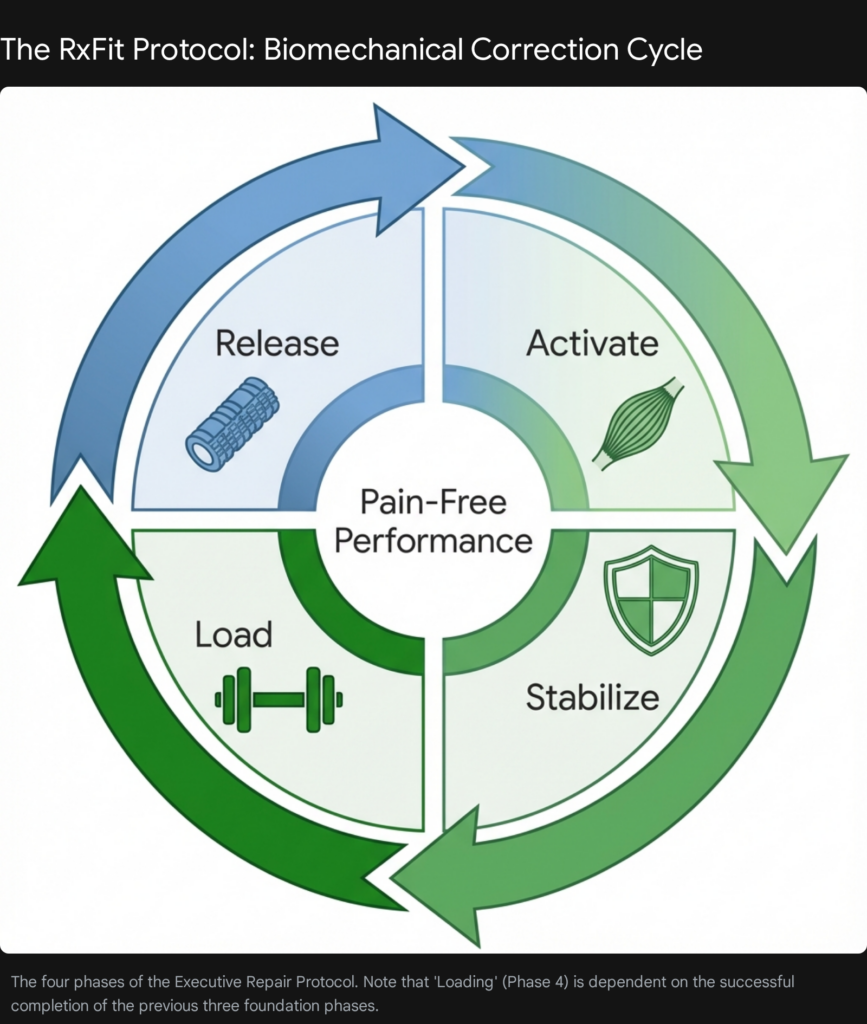
RxFit employs a structured, phased approach to shoulder repair. This is not a random “workout of the day”; it is a progressive algorithm designed to restore function before adding load. The protocol follows the logical sequence of Inhibition -> Lengthening -> Activation -> Integration.
Phase 1: Decompress & Release (The Reset)
Goal: Turn off the “brakes.”
Before strengthening can occur, the hypertonic muscles (Upper Traps, Pec Minor) must be released. If a trainer attempts to strengthen the back while the chest is structurally tight, they are effectively driving the car with the parking brake on. This creates “shear” force in the joint.
- Technique: Self-Myofascial Release (SMR) and manual trigger point therapy. The trainer teaches the client how to use tools (lacrosse balls, foam rollers, or percussive devices) to downregulate muscle tension.
- Key Target: The Pectoralis Minor. This small muscle is the “lynchpin” of anterior tilt. Releasing it allows the scapula to slide back into a neutral position.
- Key Target: The Suboccipitals. These small muscles at the base of the skull are major drivers of headache and forward head posture.
- Assessment Metric: The “Wall Slide” test. Can the client flatten their arms against a wall without their back arching or ribs flaring? If not, they remain in Phase 1.1
Phase 2: Activation & Centration
Goal: Wake up the “gas pedal.”
Once the tight muscles are released, the weak stabilizers (Lower Traps, Serratus Anterior) must be activated. These muscles are often “amnesiac”—the brain has lost the neural pathway to recruit them voluntarily.
- Technique: Isometric holds and low-load isolation. The goal is to establish a “mind-muscle connection” without recruiting the dominant Upper Traps.
- Key Movement: Scapular Retraction vs. Protraction. Teaching the client to move the shoulder blade independently of the arm (dissociation).
- The “Y-T-W-L” Series: A gold-standard protocol where the client lies prone (face down) and lifts arms in specific shapes to target the Lower Trapezius (Y), Middle Trapezius (T), Rhomboids (W), and External Rotators (L).
- Safety Rule: NO overhead pressing is permitted in this phase. All work is closed-chain (hands fixed) or isometric to ensure safety.5
Phase 3: Integration & Stability
Goal: Build the chassis.
Now that the muscles are firing, they must be integrated into complex movement patterns. The focus shifts to Rotator Cuff Stability—building “armor” around the joint capsule.
- Technique: Perturbation training and Rhythmic Stabilization. The client holds a position (e.g., a plank or a held cable press) while the trainer applies random taps or forces to the limb. This forces the reflex stabilizers of the rotator cuff to fire instinctively (reflexive firing).
- Exercise: Face Pulls. This is the quintessential “anti-desk” exercise. It trains external rotation and scapular retraction simultaneously, directly reversing the posture of typing.
- Exercise: Bottoms-Up Kettlebell Carry. Holding a kettlebell upside down forces the rotator cuff to grip the humeral head into the socket to stabilize the wobbly weight.
Phase 4: Performance Loading
Goal: Expand the asset.
Only when the joint is centrated, stable, and integrated does RxFit introduce heavy load. This is where the physique changes happen—hypertrophy (muscle growth) and maximal strength.
- Philosophy: “Earn the right to lift heavy.”
- Application: Deadlifts, Overhead Presses (now safe due to cleared impingement), Pull-ups, and dynamic movements.
- Result: The client is now training like an athlete, but with a corrected biomechanical foundation that ensures longevity. They are building muscle on a stable frame rather than piling bricks on a crooked foundation.1
5. Market Analysis: Austin’s Neighborhood Specifics
RxFit’s mobile model is not a “one size fits all” service; it is strategically deployed across Austin’s distinct executive enclaves. The service is tailored not just to the biomechanics of the client, but to the logistics and psychographics of their specific neighborhood.3
5.1 Westlake & Rollingwood: The Estate Strategy
- Demographic Profile: C-Suite Executives (Fortune 500), Founders, Family Offices, Legacy Wealth.
- Psychographics: Value privacy, exclusivity, and family health. Often have demanding travel schedules.
- Physical Environment: Large, multi-acre estates in the hills.
- The “Dead Asset” Problem: Many Westlake homes feature high-end, professionally equipped private gyms (costing $50k-$100k) that sit collecting dust because the owner lacks the motivation or knowledge to use them effectively.
- RxFit Solution: RxFit activates this “dead asset.” The trainer utilizes the client’s own high-end equipment, maximizing the ROI of their home build. The focus here is often holistic, potentially training the executive and their spouse back-to-back. The privacy of Westlake (gated driveways) aligns perfectly with the discrete nature of the service.18
5.2 The Domain & Northside: The Density Strategy
- Demographic Profile: Tech Executives (Amazon, Facebook/Meta, Vrbo), Young Founders, High-Frequency Traders.
- Psychographics: “Work hard, play hard.” Efficiency obsessed. Data-driven.
- Physical Environment: “The Second Downtown.” High-density, luxury vertical living (e.g., The Bowen, The flatiron). Walkable to corporate HQs.
- Pain Point: The “Always On” culture. These executives often work long hours and live steps from their office. The commute to a gym is non-existent, but the time to train is scarce.
- RxFit Solution: Efficiency is king. Trainers meet clients in the high-end apartment fitness centers (which rival commercial gyms) or in corporate wellness rooms between meetings. The focus is on “Micro-dosing” fitness—high-yield, intense sessions that fit into a 45-minute lunch break without the need to drive.21
5.3 Tarrytown & Downtown: The Old Guard & The New
- Demographic Profile: Legal Partners, Lobbyists, Senior Government Officials, Legacy Austin Families.
- Psychographics: Traditional, community-oriented. Value relationship and reputation.
- Physical Environment: Historic homes, tree-lined streets, proximity to the Capitol and Lady Bird Lake.
- Pain Point: Tradition vs. Innovation. Clients here often have decades of “bad reps” from traditional weightlifting or tennis elbow from years at the country club.
- RxFit Solution: Re-education and Restoration. The approach here is often more restorative, transitioning clients from damaging “powerlifting” mentalities to “longevity” protocols. Trainers may utilize the scenic outdoor spaces (like the lagoon at Laguna Gloria or private docks) for recovery sessions, blending nature with biomechanics.24

6. Economic ROI: The Value of Pain-Free Focus
The price of an RxFit session (typically ranging around $105, depending on frequency and location) is often superficially compared to a standard gym membership ($50/month) or a physical therapy copay ($30). This is a false equivalence that fails to account for the true economic variables of the executive class: Time and Cognitive Bandwidth.1
6.1 Time Arbitrage: The $2,500 Weekly Gain
For the “Industrial Athlete,” time is the scarcest resource. Traditional fitness models impose a massive “time tax” that is often invisible until audited.
Consider the workflow of a Westlake executive going to a luxury gym downtown:
- Drive to gym: 20-30 mins (Traffic on Mopac/Bee Cave Rd).
- Change/Locker room: 10 mins.
- Workout: 60 mins.
- Shower/Grooming: 15 mins.
- Drive back: 20-30 mins.
- Total Time Investment: ~2 hours 15 mins for a 1-hour workout.
RxFit Mobile Protocol:
- Trainer arrives: 0 mins (Client is already home/at office).
- Workout: 60 mins.
- Trainer leaves: 0 mins.
- Total Time Investment: 1 hour.
The Delta: RxFit saves approximately 1.25 hours per session. Over a standard frequency of 4 sessions per week, this equates to 5 hours of saved time per week.
For an executive whose billing rate or opportunity cost is $500/hour, this represents $2,500 per week in recovered opportunity cost. The service essentially pays for itself by returning the executive’s most valuable asset: their morning or evening availability.1
6.2 Cognitive Capital: The Cost of Pain
Pain is a “background process” that consumes RAM in the brain. Chronic shoulder pain (nociception) constantly triggers the sympathetic nervous system (fight or flight).
- Cortisol Elevation: Chronic pain keeps cortisol levels high, which increases anxiety, disrupts sleep, and promotes fat storage.
- Distraction: Every time the executive reaches for a phone or types an email and feels a twinge, their focus is broken. This “context switching” carries a heavy cognitive penalty.
- Decision Fatigue: Making high-stakes decisions requires peak cognitive endurance. Pain accelerates fatigue.
By eliminating pain, RxFit restores Cognitive Bandwidth. The executive is no longer fighting their own body to sit through a meeting. They are physically neutral, allowing for total mental application. RxFit positions itself, therefore, not just as a fitness service, but as a Cognitive Performance Enhancer—a tool for maintaining the “Founder’s Edge”.15
6.3 Career Longevity: Asset Durability
The ultimate ROI is career duration. You cannot run a billion-dollar company with a bankrupt body.
- The “Burnout” Shield: Physical resilience is the primary buffer against professional burnout.
- The “Presence” Factor: An executive who stands tall with open posture (retracted scapulae) projects confidence and authority. An executive with Upper Crossed Syndrome (slumped, head forward) projects fatigue and submission. Biomechanics affects not just how you feel, but how you are perceived in the boardroom.
7. Actionable Intelligence: Troubleshooting & Strategy
While the RxFit protocol is best administered by a specialist, the following strategic logic provides an immediate framework for the executive experiencing pain.
7.1 Immediate Troubleshooting Logic (Self-Triage)
Use this “If/Then” algorithm to determine your immediate course of action. This is risk management for your shoulder.
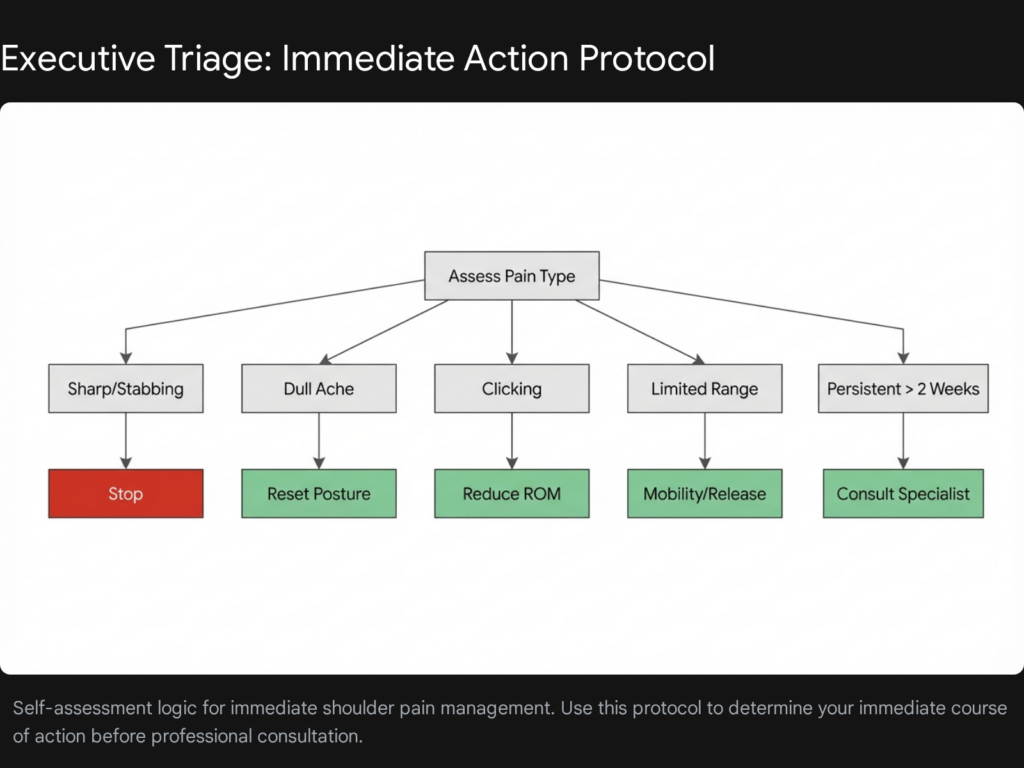
- IF pain is sharp/stabbing during movement -> THEN STOP immediately.
- Diagnosis: This indicates acute impingement (bone hitting tendon) or a soft tissue tear. Pushing through this “sharp” pain is never productive; it is destructive.
- IF pain is a dull ache while sitting -> THEN RESET posture.
- Diagnosis: Ischemic tension. Your muscles are starved of oxygen due to constant contraction. Perform Thoracic Extensions (arching over your chair back) and Chin Tucks (making a double chin) to reset the spinal alignment.
- IF you hear “clicking” without pain -> THEN CONTROL the range.
- Diagnosis: Crepitus. The tendon is snapping over a bony prominence. It is not an emergency, but it indicates instability. Continue the movement but reduce the Range of Motion (ROM) to where the clicking stops.
- IF range of motion is limited compared to the other side -> THEN RELEASE.
- Diagnosis: Soft tissue restriction. Do not force the stretch. Use a lacrosse ball or massage gun on the Pec Minor and Upper Trap to “melt” the restriction before trying to move it.
- IF pain persists for > 2 weeks -> THEN CONSULT.
- Diagnosis: Chronic dysfunction. The “Check Engine Light” has been on too long. Schedule a biomechanical consultation with RxFit.
7.2 The Equipment of the Mobile Professional
RxFit trainers bring the gym to you, but for the executive who travels, having a “Deployment Kit” is essential. The recommended “Travel Asset Protection” kit includes:
- Lacrosse Ball: For releasing the Pec Minor and Rhomboids in hotel rooms.
- Light Resistance Band (Red/Yellow): For performing “Pull-Aparts” and “Face Pulls” to activate the posterior chain after a flight.
- Theragun/Percussive Device: To downregulate hypertonic traps after a board meeting.
8. Conclusion: The Strategic Imperative
For the Austin executive, the body is not separate from the business; it is the infrastructure upon which the business is built. Ignoring structural depreciation is akin to deferring maintenance on a critical server farm or a flagship property; eventually, the asset will fail, likely at a moment of peak demand.
The “Executive Repair Protocol” offered by RxFit is not a luxury; it is a mitigation strategy. By shifting the focus from “exercise” to “corrective engineering,” and by removing the logistical friction of the commute, RxFit provides a scalable, sustainable solution for the industrial athlete. The path to a pain-free career is not found in a cortisone shot or a surgery—these are reactive failures. It is found in the disciplined, intelligent re-engineering of movement, delivered with the precision and efficiency that the modern executive demands.
Final Takeaway: Your shoulder pain is a solvable engineering problem. Treat it with the same rigor you treat your P&L. Fix the joint, clear the impingement, and build the asset.