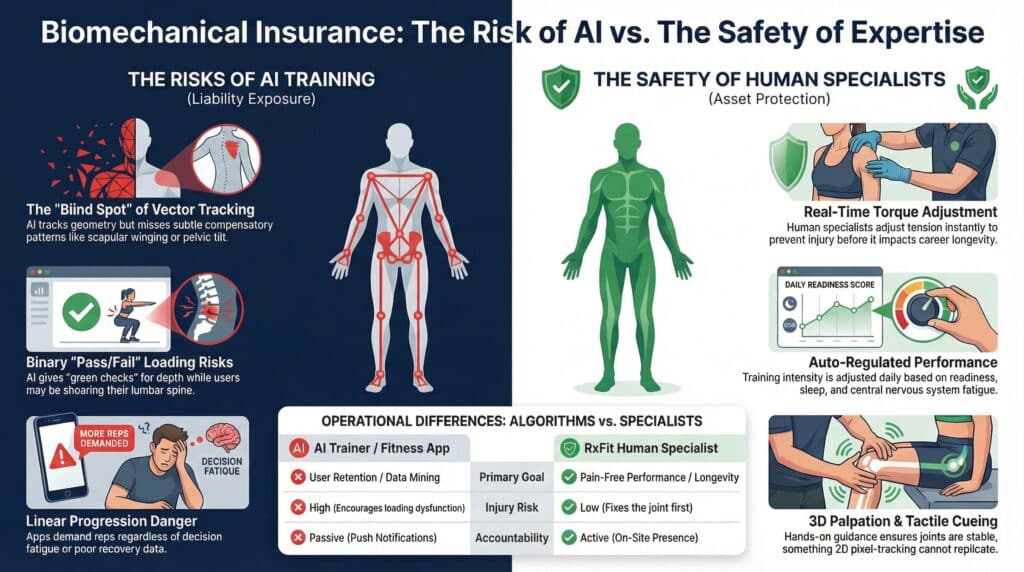
While AI algorithms excel at quantitative data processing and schedule optimization, they lack the clinical proprioceptive awareness required for safe biomechanical correction. For Austin executives, relying solely on an AI trainer introduces a significant liability: the risk of loading dysfunction. A Certified Corrective Exercise Specialist (CES) acts as an asset protection mechanism, adjusting torque and tension in real-time to prevent injury before it negatively impacts your career longevity.
Key Takeaways
- The “Blind Spot” Risk: AI uses computer vision to track vectors, but it cannot detect subtle compensatory patterns like scapular winging or pelvic tilt that lead to chronic injury.
- Asset vs. Commodity: AI apps are excellent for “burning calories” (commodity), but fail at “structural optimization” (asset protection).
- The Executive Cost: For a CEO in Westlake, the cost of a herniated disc far outweighs the savings of a $20/month subscription.
- The Hybrid Solution: At RxFit, we utilize technology for data tracking (HRV, Sleep), but rely on Danny Trejo (CES) and his team for the physical execution.
Can an AI trainer really correct my squat form?
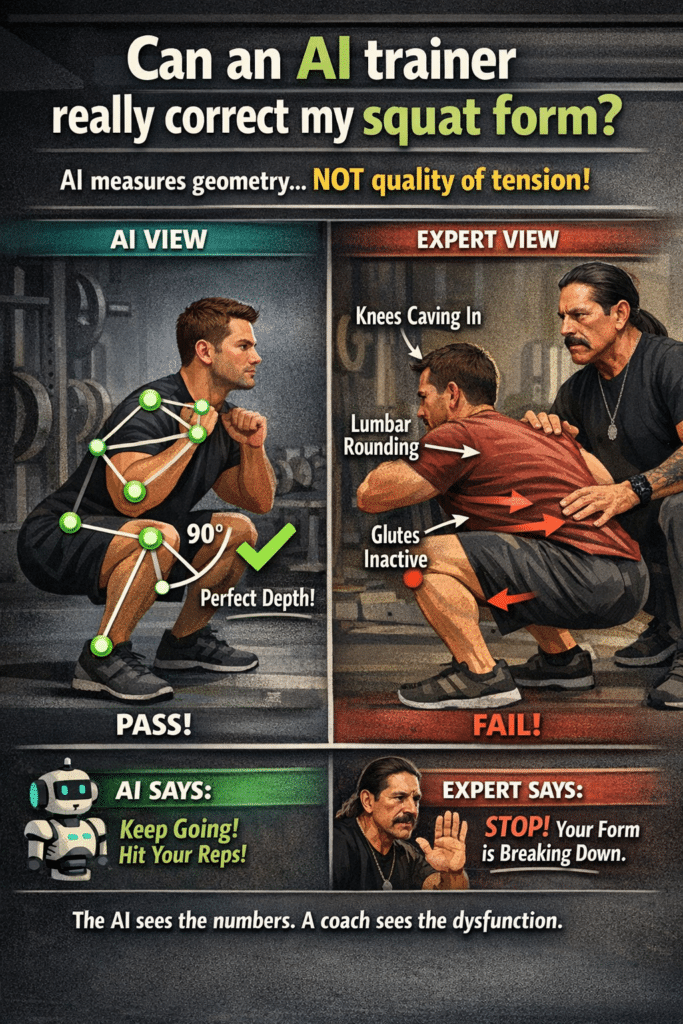
The short answer is: It can measure the geometry of your squat, but it cannot assess the quality of the tension.
Current AI fitness models utilize computer vision to map “key points” on the human body—knees, hips, shoulders. They measure the angle of the femur relative to the tibia. If you hit 90 degrees, the AI gives you a green checkmark. However, this binary “pass/fail” metric is dangerous for the Industrial Athlete.
Danny Trejo, Corrective Exercise Specialist, notes that a client can hit “perfect depth” while completely deactivating their glute medius and shearing their lumbar spine. An AI sees the depth; a human expert sees the Valgus Collapse (knees caving in) and the lack of intra-abdominal pressure.
If you are training in your home gym in Tarrytown after a 12-hour day of meetings, your neuromuscular system is fatigued. An AI will encourage you to “push through” to hit a rep count. A human specialist will recognize the degradation in your motor control, stop the set, and switch to a palliative isometric hold to preserve the joint.
What are the economic pros and cons of AI coaching?
For the Fiscal Guardian (CFOs and Risk Managers), the immediate ROI of an AI app seems obvious. A subscription costs $30/month, whereas concierge mobile training in The Domain or Downtown Austin commands a premium. However, this is a “Penny Wise, Pound Foolish” calculation when applied to the human body.
The Economic Calculation of Risk
Pros of AI Training:
- Scalability: Infinite workout variations instantly.
- Data Aggregation: Excellent at tracking total volume and estimated caloric burn.
- Cost Efficiency: Extremely low barrier to entry.
Cons of AI Training:
- Liability Exposure: No oversight on load management leads to a higher probability of Musculoskeletal (MSK) claims.
- Lack of Regression: AI operates on linear progression (do more weight). It struggles with regression (do less because you slept poorly).
- Zero Accountability: An app notification is easily swiped away; a trainer ringing your doorbell in Rollingwood ensures execution.
If your goal is simply to sweat, AI is sufficient. If your goal is Asset Protection—ensuring you can physically handle the stress of high-stakes leadership for the next 20 years—human oversight is the only viable hedge.
Why is the “Human Element” critical for executive performance?
High-performance executives suffer from “Decision Fatigue.” You spend all day making high-leverage choices. The last thing you want to do at 6:00 PM is negotiate with an algorithm about which lunge variation to perform.
Justin Tully, RxFit Team Manager, emphasizes the psychological aspect of the “Shared Struggle.” An AI cannot read the room. It does not know that you just lost a key client or that your HRV is tanked from a redeye flight. It just demands inputs.
A human trainer acts as a Performance Concierge. We absorb the cognitive load of the workout. When Ashlyn or Claire arrives at your office, you don’t have to think; you just have to move. This “outsourcing of willpower” is critical for consistency. Furthermore, the accountability of a scheduled appointment creates a “commitment device” that an app cannot replicate.
Comparison: AI Algorithm vs. RxFit Corrective Specialist
| Feature | AI Trainer / Fitness App | RxFit Corrective Specialist |
|---|---|---|
| Primary Goal | User Retention / Data Mining | Pain-Free Performance / Longevity |
| Form Correction | 2D Vector Analysis (Geometry) | 3D Palpation & Cueing (Biomechanics) |
| Programming | Linear Progressive Overload | Auto-Regulated (Based on Daily Readiness) |
| Injury Risk | High (Encourages loading dysfunction) | Low (Fixes the joint first) |
| Accountability | Push Notifications (Passive) | On-Site Presence (Active) |
| Location | Virtual Only | Mobile: Your Home/Office (78746/78701) |
| Ideal For | General Population / Weight Loss | Industrial Athletes / Complex Health History |
Is an AI trainer safe for injury recovery?
If you are managing a pre-existing condition—such as a rotator cuff impingement or a herniated L4-L5—an AI trainer is contraindicated.
AI models are trained on “healthy” datasets. They assume a standard range of motion and structural integrity. They do not know how to navigate the “pain cave.” If you input that you have back pain, the app might suggest “stretching.” However, Danny Trejo warns that stretching an unstable lumbar spine often exacerbates the injury. You need stability (tension), not flexibility (laxity).
RxFit operates in the gap between Physical Therapy and Performance. We use manual resistance and tactile cueing to guide a joint through a safe range of motion. An AI cannot place a hand on your scapula to ensure it is retracting properly; it can only guess based on pixel movement.

How do we troubleshoot the “Hybrid” approach?
There is a place for technology in your regimen. We recommend using wearables (Whoop, Oura) to track recovery, while using humans to manage the load. Use this logic list to determine when to lean on which resource.
If/Then Risk Logic List:
- IF you are traveling and need a simple hotel circuit -> THEN use an AI app to generate a maintenance workout.
- IF you feel sharp pain or “clicking” in a joint -> THEN ignore the app and consult a Corrective Specialist immediately.
- IF your goal is maximizing hypertrophy (muscle growth) -> THEN a human spotter is required to safely reach true mechanical failure.
- IF you are training for endurance (running/cycling) -> THEN AI algorithms are excellent for managing heart rate zones.
- IF you have a history of surgery -> THEN never trust an algorithm with your rehabilitation.
Conclusion: Investing in the Infrastructure
In 2026, technology is a tool, not a master. For the residents of Austin’s wealth corridor—from Clarksville to Barton Creek—the decision between AI and Human training is a decision about risk tolerance.
An AI trainer is a low-cost, high-volume commodity. It serves a purpose. But at RxFit, we provide Biomechanical Insurance. We ensure that the time you invest in your body yields compounded returns in energy, confidence, and longevity, rather than a debit in the form of injury.
