
Simple doesn’t mean easy
RxFit resolves chronic lower back pain in executives by combining cellular mineral hydration with corrective biomechanics. Avoiding water to save time dehydrates the fascial system, shrink-wrapping muscles and compressing the lumbar spine. By utilizing high-mineral water, we restore tissue malleability, eliminate back pain, and optimize the executive asset without interrupting daily meeting schedules.
Key Takeaways
- Asset Depreciation: Chronic lower back pain is rarely a mere consequence of “aging”; it is frequently a systemic environmental failure caused by severe fascial dehydration and prolonged sedentary postures.
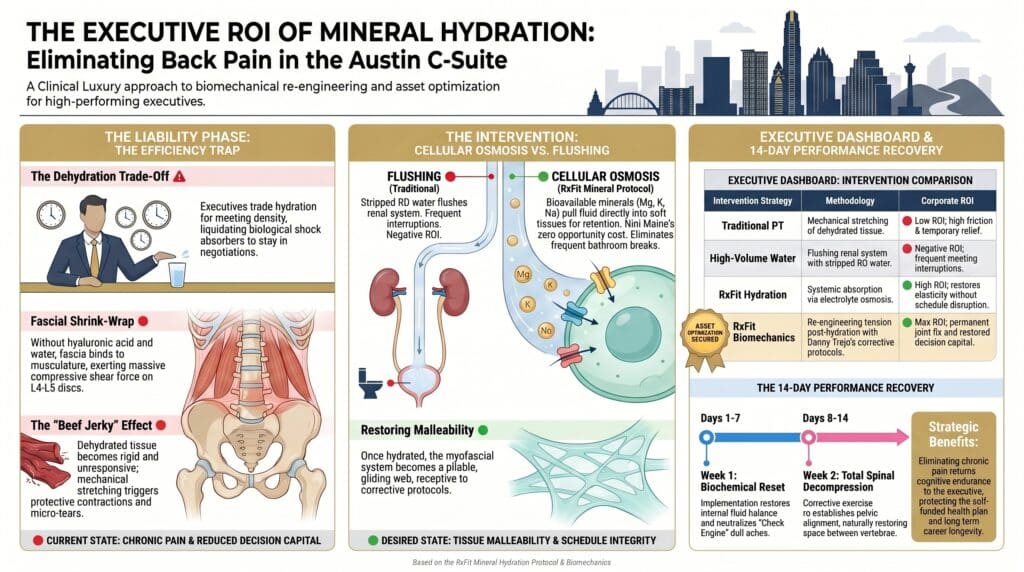
- The Efficiency Trap: Trading hydration for meeting efficiency (avoiding water to prevent bathroom breaks) liquidates your biological shock absorbers, leading to severe spinal compression.
- Cellular Osmosis vs. Flushing: Plain, stripped water simply flushes through the kidneys; high-mineral content water pulls moisture directly into the soft tissues, hydrating the body at a cellular level.
- Biomechanical ROI: Led by Corrective Exercise Specialist Danny Trejo, the RxFit protocol repairs rigid, unresponsive muscles to ensure pain-free performance and extended career longevity for executives in Westlake and The Domain.

Biomechanical ROI: Led by Corrective Exercise Specialist Danny Trejo, the RxFit protocol repairs rigid, unresponsive muscles to ensure pain-free performance and extended career longevity for executives
Why does chronic dehydration cause lower back pain in executives?
For the “Industrial Athlete”—the high-performing CEO, CFO, or Sales Director operating in Austin’s competitive business landscape—time is the ultimate non-renewable resource. Every minute spent away from negotiations or strategic planning is viewed as an opportunity cost. This relentless drive for efficiency often leads to subconscious compromises in physical health, the most insidious of which is intentional dehydration.
To understand this liability, we must examine a recent clinical case study from our RxFit files involving Shane, a high-leverage Sales Director. Shane presented with chronic, debilitating lower back pain. His daily routine involved continuous transit—driving on Mopac, sitting in endless boardroom meetings in Downtown Austin, and traveling constantly. When our clinical team audited his daily habits, we uncovered a dangerous efficiency hack: Shane actively avoided drinking water during the workday because he felt he could not afford to waste time looking for a restroom between meetings. He was trading his hydration for schedule optimization.
This trade-off triggered a catastrophic chain of biomechanical failures. The human fascial system is a continuous, highly innervated web of connective tissue that encases every muscle, bone, and nerve in the body. To function properly, fascia relies on hyaluronic acid and water to glide and stretch. When you intentionally dehydrate your body, this fascial system becomes “shrink-wrapped.” It loses its elasticity, binding down on the underlying musculature. For an executive sitting for 10 to 12 hours a day, this fascial binding actively pulls the pelvis out of alignment and exerts massive compressive shear force on the lumbar vertebrae (specifically the L4-L5 discs). Shane was not experiencing a random injury; his body was executing a predictable mechanical failure resulting from systemic dehydration and asset neglect.
Why do traditional corrective exercises fail dehydrated tissue?
When an executive experiences lower back pain, the standard reaction is to seek out a traditional personal trainer or a baseline physical therapy clinic. The typical prescription involves generic stretching protocols or core strengthening exercises. However, applying mechanical intervention to a chemically compromised system is an exercise in futility.
Danny Trejo, Corrective Exercise Specialist and Founder of RxFit, emphasizes that you cannot remodel compromised tissue without addressing its internal environment first. “When I first assessed Shane and attempted manual myofascial release, his muscles were incredibly resistant,” Trejo notes. “They felt rigid, glued down, and entirely unresponsive to the mechanical work we were doing. You cannot stretch or remodel beef jerky, and that is essentially what Shane’s muscles had become due to chronic dehydration.”
Traditional corrective exercises fail in this scenario because they assume the muscle tissue possesses a baseline level of malleability. If the fascial system is starved of the fluid it requires to expand, contract, and absorb shock, stretching it only triggers the Golgi tendon organs to initiate a protective contraction. The body fights the stretch, creating micro-tears rather than elongating the tissue.
For Shane, the initial attempts at spinal decompression and traditional corrective protocols provided only fleeting relief, lasting perhaps 6 to 12 hours before the shrink-wrapped fascia pulled his lumbar spine right back into a state of compression. As a longevity trainer focused on Asset Optimization, Trejo recognized that continuing to force mechanical tension onto dehydrated tissue was not just ineffective—it was a liability that could accelerate structural depreciation.
What is the difference between mechanical intervention and cellular hydration?
The paradigm shift required to resolve chronic, dehydration-induced back pain lies in distinguishing between mechanical intervention (stretching, foam rolling, massage) and cellular hydration. Shane did not just need a better stretch or a more aggressive massage gun; he needed a fundamental change to his systemic environment.
However, the solution was not as simple as telling a busy executive to “drink a gallon of water.” If Shane were to suddenly consume a gallon of standard, reverse-osmosis (stripped) water, it would run straight through his renal system, forcing him into the exact bathroom breaks he was trying to avoid. This would violate the primary directive of his workday efficiency.
The RxFit protocol required a strategic, clinical upgrade: High-Mineral Content Water. By adding specific, bioavailable minerals (like sodium, magnesium, and potassium) to his water, we fundamentally altered how his biology processed the fluid. Instead of merely flushing through his kidneys and filling his bladder, the electrolytes facilitated cellular osmosis. The minerals acted as a transport mechanism, pulling the water into the soft tissues and retaining it at a cellular level. This is the difference between simply drinking water and actually achieving cellular hydration.
Below is the Executive Dashboard comparing the efficacy of different interventions for managing dehydration-induced back pain:
| Intervention Strategy | Methodology & Application | Corporate ROI & Executive Impact |
|---|---|---|
| Traditional Physical Therapy | 🔴 Mechanical stretching of dehydrated tissue (Symptom management). | 🔴 Low ROI. Temporary relief; high friction (requires commuting and waiting rooms). |
| High-Volume Plain Water | 🟡 Flushing the renal system with stripped RO water. | 🔴 Negative ROI. Causes frequent urination, interrupting critical executive meeting schedules. |
| RxFit Cellular Hydration (Mineral) | 🟢 Systemic absorption via electrolyte-driven osmosis. | 🟢 High ROI. Restores tissue elasticity without disrupting the daily executive calendar. |
| RxFit Corrective Biomechanics | 🟢 Re-engineering tension post-hydration (NASM-CES protocols). | 🟢 Maximized ROI. Fixes the joint permanently, eliminating pain and restoring decision capital. |
Accent Insight: You cannot optimize your external performance if you are chronically dehydrating your internal shock absorbers. Cellular hydration is the prerequisite for biomechanical repair.
How did the Mineral Hydration eliminate back pain in two weeks?
The implementation of the high-mineral hydration protocol yielded rapid, profound, and highly measurable results. By prioritizing the internal biochemical environment before applying heavy mechanical loads, the RxFit protocol delivered three distinct operational victories for Shane within just 14 days.
1. Schedule Maintained (Zero Opportunity Cost) The primary concern for the Fiscal Guardian or Industrial Athlete is the loss of time. Because the high-mineral water allowed Shane’s tissues to actually absorb and retain the fluid, he was not constantly running to the restroom. His meeting schedule, transitions between corporate offices in The Domain, and long drives across Austin remained entirely uninterrupted. We solved the biological problem without creating an operational bottleneck.
2. Tissue Malleability Restored Once the cellular hydration took effect, Shane’s “beef jerky” muscles began to soak up the moisture like a biological sponge. The myofascial system transitioned from a rigid, shrink-wrapped cage into a pliable, gliding web. When Danny Trejo reintroduced the corrective exercise protocols and manual tissue work, the interventions finally took hold. The muscles were now malleable enough to expand, adapt, and permanently hold the new structural alignment.
3. Total Spinal Decompression With the musculature properly hydrated and the fascial binding released, the chronic tension pulling on Shane’s pelvis was neutralized. The lumbar vertebrae were allowed to decompress naturally, restoring the critical space between the L4-L5 discs. Within two weeks of combining this specific mineral hydration strategy with our mobile corrective training, Shane’s debilitating back pain was entirely eliminated. He recovered his cognitive endurance and secured his physical asset for long-term career longevity.
How do I troubleshoot lower back pain and dehydration?
If you are an executive managing a multi-million-dollar portfolio, you must apply the same rigorous risk-management framework to your own biology. Do not ignore the body’s “Check Engine” lights. Use the following RxFit logic flow to perform immediate somatic triage and determine if your pain is rooted in systemic dehydration or structural failure.
If/Then Musculoskeletal Risk Logic List:
- IF your muscles feel rigid, tight, and completely unresponsive to deep tissue massage or stretching -> THEN you are suffering from fascial dehydration; immediately switch to high-mineral content water to restore cellular malleability.
- IF you are avoiding water consumption to prevent bathroom breaks during consecutive Zoom meetings -> THEN you are actively depreciating your biological asset and accelerating spinal compression.
- IF you experience sharp, stabbing pain radiating down your leg (sciatica) -> THEN stop all movement immediately; this indicates acute nerve impingement requiring clinical assessment, not just hydration.
- IF your lower back aches dully after 8 hours of sitting in your Downtown Austin office -> THEN perform standing thoracic extensions and consume 16 ounces of electrolyte-dense fluid to reset spinal alignment and rehydrate the lumbar discs.
- IF traditional physical therapy has failed to provide relief lasting longer than 12 hours -> THEN your pain is likely driven by an unaddressed systemic environment issue; schedule a comprehensive biomechanical and nutritional audit.
What is the ROI of treating your body as a corporate asset?
For the Austin executive class, physical pain is not merely a somatic nuisance; it is a strategic business liability. When you are forced to manage chronic lower back pain, a significant portion of your brain’s processing power is diverted toward pain modulation. This drain on your central nervous system drastically reduces your “decision capital,” leaving you cognitively fatigued and highly susceptible to burnout.
From a purely economic perspective, treating your body as your most highly prized capital asset yields the greatest Return on Investment in your portfolio. Traditional commercial fitness models fail the executive because they impose a massive “time tax.” Driving from a home in Rollingwood or Clarksville to a crowded gym, navigating parking, executing a chaotic workout, and showering can consume over two hours. For a CEO whose time is valued at $500 to $1,000 an hour, this commute is an unacceptable drain on operational bandwidth.
RxFit leverages Time Arbitrage to maximize your ROI. By deploying our Corrective Exercise Specialists directly to your private estate in Tarrytown or your corporate headquarters in Silicon Hills, we completely eliminate the friction of the commute. We return hours of valuable availability to your week, allowing you to invest that recovered opportunity cost back into your business or your family. More importantly, by mitigating musculoskeletal risk and eliminating chronic pain through protocols like the one used for Shane, we protect your self-funded health plan variance and ensure that your physical infrastructure matches the scale of your financial ambition.
How does RxFit integrate functional nutrition and biomechanics in Austin?
To truly optimize the executive asset, you cannot silo movement and nutrition. The Shane case study perfectly illustrates why a holistic, integrated approach is mandatory for high-performance longevity. You can program the most advanced, biomechanically perfect corrective exercises in the world, but if the client’s tissue is chronically dehydrated or under-fueled, the mechanical intervention will fail.
At RxFit, we operate as a unified risk management team. Nini Maine, our Functional Nutritionist, oversees the systemic biochemical environment. Whether it involves designing a Gastroparesis-Friendly Low-Energy Ketogenic Therapy (LEKT) protocol to prevent muscle wasting for clients on GLP-1 agonists, or formulating the precise mineral hydration strategy to cure Shane’s fascial binding, her interventions ensure the body has the raw materials required for adaptation. We do not prescribe generic “diets”; we prescribe functional fueling systems that eliminate decision fatigue.
Simultaneously, Danny Trejo and our team of Corrective Exercise Specialists handle the mechanical signaling. We do not offer “sweat sessions” or act as “rent-a-friend” trainers. We utilize rigorous, clinical protocols to fix Upper Crossed Syndrome, correct scapular dyskinesis, and decompress the lumbar spine. We fix the joint first, ensuring that when we finally introduce heavy loads, your body is structurally sound and capable of true performance optimization.
We deliver this concierge-level integration directly to your door anywhere within Austin’s wealth corridor—including Westlake, Barton Creek, The Domain, and Downtown Austin. Stop trading your long-term physical health for short-term scheduling efficiency. Protect the P&L, optimize the asset, and build the physical infrastructure required for high-stakes leadership
