
Wrist pain when lifting is almost never actually a wrist problem. It’s a kinetic chain failure — tight forearm extensors, compromised thoracic mobility, or misaligned grip mechanics conspiring to dump load into your radiocarpal joint. As a Corrective Exercise Specialist who works with Austin executives daily, I fix this by tracing the pain upstream to its actual origin, not just bracing the symptom.
Why Do Your Wrists Hurt When You Lift?
Your wrists are the last domino, not the first. When you press a barbell overhead or rack a heavy front squat, force travels through your entire upper extremity — from the scapulae, through the thoracic spine, down through the shoulders, elbows, and finally the wrist. If any joint upstream is restricted, the wrist absorbs the deficit.
The most common culprit I see in my Austin clients? The extensor carpi radialis longus and brevis — two muscles that sit across the top of the forearm. When these become hypertonic (chronically tight from gripping, typing, or — and I see this constantly in Westlake and Tarrytown — death-gripping a pickleball paddle for three hours), they restrict wrist extension under load. Your brain interprets this restriction as pain localized to the wrist joint itself.
The critical distinction: where you feel pain is not necessarily where it originates. Once you internalize that concept, rehabilitation becomes a strategic operation instead of a guessing game.
Restricted thoracic spine mobility is the silent contributor almost nobody considers. When your T-spine can’t extend properly — common in executives hunched over a laptop in a Downtown Austin high-rise — your shoulders compensate by internally rotating. This pushes your wrists into excessive extension during pressing movements, creating shearing forces across the scapholunate ligament and the radiocarpal complex.
Is Wrist Pain From Lifting Serious?
It depends entirely on the timeline. A passing discomfort after a heavy set of clean-and-jerks? That is a signal — something upstream is restricted, and it is manageable. Ignore that signal for six months while you continue loading improperly? Now you are looking at extensor tendinopathy.
Research published in the British Journal of Sports Medicine shows tendon pathology progresses through three stages: reactive tendinopathy, tendon disrepair, and degenerative tendinopathy (Cook & Purdam, 2009). The window for conservative intervention is widest in stage one. By stage three, you may need medical intervention.
This is why I approach wrist pain with urgency. Every week that a Barton Creek executive trains through wrist pain without addressing the kinetic chain is a week closer to a threshold they cannot easily reverse.
How Do You Fix Wrist Pain During Bench Press?
Three clinical adjustments that produce measurable relief — often within a single session:
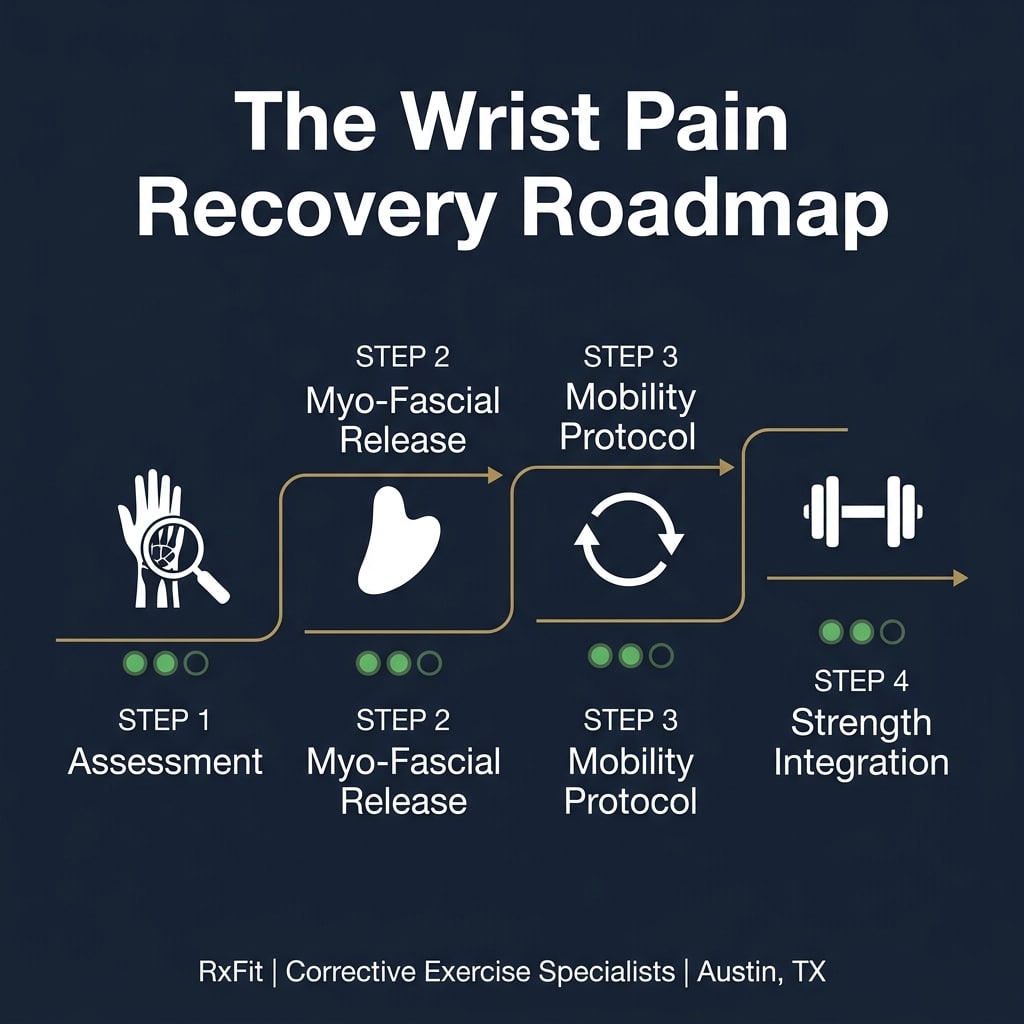
- The Stacking Principle. Your wrist, elbow, and shoulder joints must be vertically stacked under load. If the barbell sits too high in the palm, the wrist hyperextends and absorbs the load. Grip the bar so it sits directly over the radius bone — the thick bone on the thumb side of your forearm — creating a straight line of force from barbell to elbow.
- Thoracic Mobilization. Before pressing, spend three minutes on thoracic extension over a foam roller at the T4-T8 vertebrae. This restores the shoulder’s natural movement arc and reduces compensatory wrist extension. Research in the Journal of Orthopaedic & Sports Physical Therapy confirms thoracic manipulation improves shoulder function and reduces distal joint compensation (Mintken et al., 2010).
- Forearm Extensor Release. Using a lacrosse ball or Gua Sha blade, work the extensor muscle belly approximately three finger-widths below the lateral epicondyle with sustained pressure for 60-90 seconds per forearm. This breaks myofascial adhesions and restores tissue extensibility. Not pleasant. Extremely effective.
What Does a Real Wrist Correction Look Like?
I had a charming executive assistant — let’s call her Mila — who came to me while managing the CEO’s calendar at a major Austin aerospace firm. She was doing a significant amount of CrossFit: pull-ups, handstand walks, kettlebell work, Olympic lifting. Essentially, she was asking her forearm extensors to perform under extreme and repetitive load, on top of a day job requiring constant fine-motor precision.
Her extensor carpi radialis muscles were incredibly taut and had virtually no capacity to lengthen through a functional range. Like most driven people I work with, she was convinced the problem was in the wrist joint — because that is where the pain showed up.
The solution was straightforward. Those muscles were accustomed to high blood flow and responded rapidly to Gua Sha — an instrument-assisted technique that works along the muscle grain with emollient to break knotted tissue and restore sliding surfaces between fascial layers. A normal corrective routine with targeted wrist mobility modifications eliminated the pain.
Sometimes it only takes one session. That is not a marketing claim — it is a function of tissue hydration, circulation to the muscle, and how early you intervene. Mila was back to handstand walks within two weeks because she came to me before the tendon crossed into disrepair territory. Your results will depend on how long you have been compensating and whether you are willing to address the actual cause rather than taping over the symptom.
Can Anti-Inflammatory Nutrition Reduce Wrist Pain?
Yes — and this is where I bring in our Functional Nutritionist, Nini Maine. What you eat directly affects how your joint capsules behave under load. Nini works with our clients to build dietary protocols that reduce systemic inflammation, allowing joint capsules to move freely without excessive pressure on surrounding nerves.
A meta-analysis published in Pain (Goldberg & Katz, 2007) demonstrated that omega-3 fatty acids significantly reduce inflammatory joint pain through suppression of prostaglandin E2 synthesis. Practically: wild-caught salmon, sardines, or fish oil dosed at 2-3 grams EPA/DHA daily.
Collagen synthesis is equally critical. A study in the American Journal of Clinical Nutrition (Shaw et al., 2017) found that 15 grams of gelatin enriched with vitamin C, taken 60 minutes before exercise, doubled the rate of collagen synthesis in tendons and ligaments. Combine that with reduced processed seed oils and curcumin supplementation, and you have created a biochemical environment that supports joint capsule mobility at the cellular level.
Why Standard Physical Therapy Falls Short for Lifters
Traditional PT returns you to baseline function — walking, opening jars, daily activities. It is not designed to return you to a 225-pound bench press or a bodyweight Turkish get-up. That gap between ”functional” and ”performance-ready” is exactly where RxFit operates.
Our corrective approach audits your entire kinetic chain, identifies every compensation, and reprograms your movement patterns with precision that a 45-minute PT clinic visit — shared between three other patients — simply cannot match. We deliver this directly to your home or office in Austin.
Frequently Asked Questions
Should I wear wrist wraps to fix wrist pain when lifting?
Wrist wraps externally stabilize the joint without addressing the kinetic chain dysfunction. Use them temporarily while working on forearm mobility and thoracic extension, but do not rely on them long-term — they can weaken wrist stabilizers over time.
How long does it take to fix wrist pain from lifting?
Early-stage reactive tendon issues can resolve in 1-3 sessions with proper myofascial release and technique correction. Chronic tendinopathy may require 6-12 weeks of structured corrective programming.
Can I keep lifting while fixing my wrist pain?
In most cases, yes — with intelligent load management. We modify grip positions, reduce volume on aggravating movements, and substitute exercises that maintain training stimulus without overloading compromised tissues.
Is wrist pain from lifting a sign I should see a doctor?
If you experience acute swelling, loss of grip strength, numbness in the fingers, or pain persisting at rest for more than two weeks, consult a physician. For biomechanical dysfunction — which accounts for the majority of lifting-related wrist pain — corrective exercise is your primary intervention.
Your wrist pain is telling you something. The question is whether you listen now or pay for it later.
At RxFit, we trace pain to its source and engineer a precision correction — delivered privately to your home in Austin. Book a complimentary movement screen and let’s find out what your wrists are actually trying to tell you.
Want ongoing clinical insights? Subscribe to the RxFit Newsletter for weekly corrective exercise intelligence.
Danny Trejo is a Certified Corrective Exercise Specialist and the founder of RxFit, Austin’s premier in-home personal training and longevity company. For inquiries, contact us here.
